
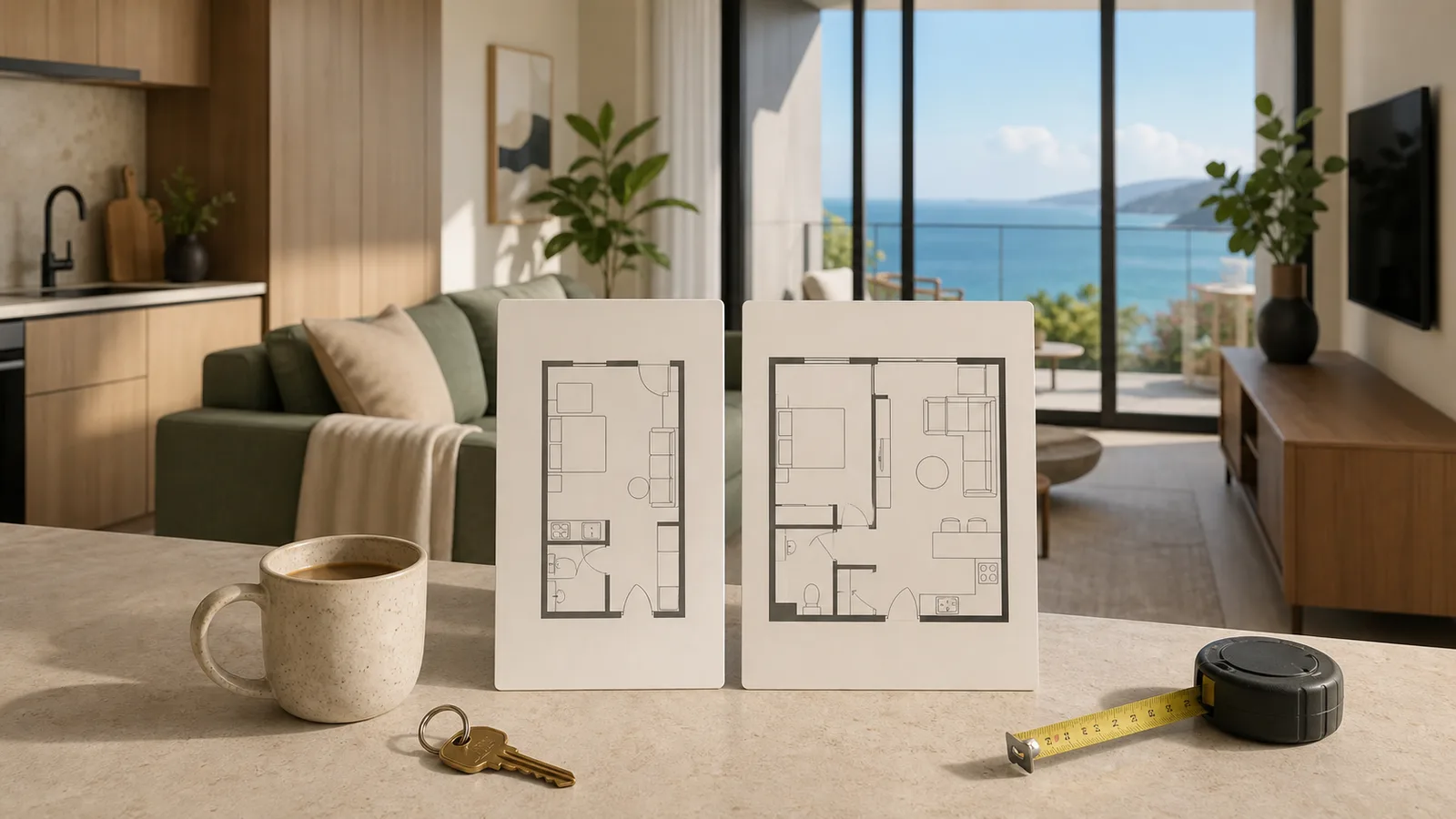
Choosing between a studio and a 1-bedroom apartment is not only a lifestyle decision. For investors, it affects purchase price, furnishing budget, rental audience, nightly rates, long-stay demand, and resale liquidity.
At Maroni Hills Residence 3, both formats can work. The better choice depends on whether your priority is lower entry cost, stronger holiday-rental flexibility, or long-term buyer appeal.
Studios: Lower Entry Cost, Simpler Management
Studios are attractive because the purchase price is lower and the furnishing plan is simpler. A well-designed studio can serve solo travelers, digital nomads, couples, and short-stay guests who want a clean base near the coast without paying for unused space.
The main advantage is yield compression: when the entry price is lower, even moderate rental income can produce an attractive percentage return. Studios also tend to have lower utility costs and less furniture to replace.
1-Bedroom Apartments: Broader Demand
One-bedroom apartments usually appeal to a wider audience. Couples, retirees, work-from-anywhere guests, and medium-stay tenants often prefer a separate bedroom. That separation improves comfort for stays of one week or longer and can support stronger average nightly rates.
The exit market may also be deeper. A 1-bedroom unit can appeal to investors, holiday-home buyers, and owner-occupiers, while studios are more tightly linked to investment logic.
The Practical Decision
If your goal is the lowest possible entry price and you are comfortable with active short-term rental management, a studio can be efficient. If your goal is flexibility, stronger medium-stay appeal, and broader resale demand, a 1-bedroom apartment is usually safer.
For buyers who are also reviewing the Cyprus residency investment threshold, any multi-unit strategy should be checked against the current official criteria and a lawyer’s advice before it is treated as viable. It may help diversify rental risk, but it is not an automatic residency solution.
Investor Takeaway
The strongest investment is not always the cheapest unit. It is the unit with the clearest guest profile, realistic furnishing plan, reliable management, and a credible exit market. Ask for current availability, projected rental assumptions, and unit-specific costs before deciding.
Request the Maroni Hills investment pack to compare current studios and 1-bedroom units.
Compare the Current Maroni Hills Inventory
The current approved inventory includes available studios from 36.75 m² to 40.10 m² and available apartments from 43.50 m² to 47.65 m². The lowest available entry price is currently Unit 102 at EUR 140,000 + VAT, while the apartment units offer larger layouts and a broader personal-use profile.
A fair comparison should use the complete acquisition basis: price, VAT, furnishing, financing cost, management setup and annual ownership costs. Then compare realistic revenue assumptions by unit type. A lower purchase price can improve percentage yield, but only if occupancy and nightly rate remain credible. A larger unit may produce a lower headline yield but attract longer stays or a wider resale audience.
Decision Matrix
Choose a studio when the priority is lower capital exposure, simpler furnishing and a clearly defined guest profile. Choose a one-bedroom when the priority is personal comfort, medium-stay demand, a separate bedroom and broader exit flexibility. Buyers considering more than one residence should also examine concentration risk: two smaller units can diversify vacancy, but create two sets of furnishing, maintenance and management costs.
Project Next Step
Request unit-specific rental assumptions for Unit 201 and the available apartment residences. Compare the net cashflow after every deduction rather than applying the same 8% headline to every layout.
Fact-Checked Buyer Notes
For Maroni Hills Residence, studio versus one-bedroom investment choice should be handled as one part of a full purchase file. The development can explain its location, developer-direct route, apartment mix, current pricing context, purchase options, and managed-rental positioning. It cannot confirm a buyer’s legal status, tax position, financing outcome, immigration eligibility, insurance cover, bank approval, or future rental performance. Those points depend on documents and advisers.
What Is Confirmed
Studio and apartments can serve different budgets, guest profiles, furnishing costs, owner-use patterns, and resale audiences.
The current project position is also specific enough for a buyer to ask useful questions. Maroni Hills Residence is a developer-direct apartment project in Maroni, Larnaca district, with studio and apartment inventory, coastal access, village character, and a stated managed-rental programme target that must be checked against final written terms. The website, brochure, availability page, and project team should all support the same basic file: who the developer is, which unit is being discussed, what the price and VAT position are, what the intended use is, and which documents will be reviewed before reservation.
A careful buyer should keep four categories separate. First are fixed project facts, such as location, unit type, area, availability status, parking, view, stated starting price, developer identity, and contact details. Second are public rules, such as registration services, tax rules, land-transfer procedures, immigration criteria, or official market statistics. Third are professional opinions, which should come from independent lawyers, tax advisers, immigration advisers, lenders, insurers, or managers. Fourth are personal assumptions, such as how often the buyer will visit, what net income would be acceptable, what risk level feels comfortable, and how long the buyer expects to hold the property.
What This Guide Does Not Prove
Residency planning around more than one unit should be reviewed only against the current official criteria and a lawyer’s advice. Do not assume a combined-unit strategy works automatically.
This distinction matters because buyers often read property content while trying to answer several questions at once. They may be comparing price, lifestyle, residence planning, rental yield, family use, tax, and resale. The same apartment can be a good fit for one goal and a poor fit for another. A studio chosen for entry price may not match the same buyer’s personal-use expectations. A one-bedroom chosen for comfort may not produce the lowest all-in cost. A managed-rental offer may be attractive, but only if the owner understands the calculation base, exclusions, cost responsibilities, and reporting method. A residency discussion may be useful, but only if it is checked against the current official criteria and the buyer’s personal documents.
No claim in this guide should be treated as a replacement for the final reservation agreement, sale contract, management agreement, tax memorandum, bank approval, insurance schedule, or immigration file. If a point matters to the decision, the buyer should ask where it appears in writing and who is professionally responsible for confirming it.
Applying This to Maroni Hills Residence
The strongest use of this guide is as a preparation tool before contacting the developer or advisers. A buyer can read the article, choose the sections that affect their own decision, and turn those sections into written questions. The sales team can then answer project-specific points, while independent advisers can answer legal, tax, immigration, banking, or insurance points. This keeps the conversation clear and avoids asking the developer to answer questions that properly belong to another professional.
For owner-occupiers, studio versus one-bedroom investment choice affects comfort, timing, travel routine, budget, and confidence after handover. For investors, it affects cashflow assumptions, guest or tenant profile, operating friction, documentation, and exit value. For residency-minded buyers, it may affect how the property purchase is structured and evidenced, but it should never be treated as a shortcut around official criteria. For overseas buyers, it also affects remote communication: documents should be named clearly, dated, and kept in one purchase file so advisers in different countries are reviewing the same facts.
The village-coastal setting also deserves practical testing. Maroni is not trying to be a dense city centre or a resort strip. The value proposition is calmer: stone-village character, access to Zygi and the coast, regional links, and a more distinctive Mediterranean ownership story. That can be a strength for the right buyer, especially if the property is presented, managed, and documented professionally. It can also be the wrong fit for a buyer who wants nightlife, a walk-everywhere city routine, or a purely hands-off asset with no adviser review.
Questions To Put In Writing
- Is the buyer prioritising entry price, income, personal use, or exit value?
- Which unit has the stronger view, layout, and outdoor space?
- How do furnishing and management costs differ?
- Would a couple or remote worker prefer one-bedroom space?
- Could any package be reviewed against residency criteria by an adviser?
Add two broader questions to that list. First, ask what would make the buyer pause. This is not negative thinking; it is discipline. Some open points are normal and can be handled with documents or pricing. Others affect the core reason for buying. Second, ask what evidence will still matter at resale. Good records are useful not only before purchase but throughout ownership. They can support rental reporting, maintenance history, tax records, insurance claims, and a later buyer’s confidence.
Buyer File Checklist
A useful file should include the project brochure, current unit particulars, floor plan, price and VAT notes, availability status, reservation terms, payment schedule, adviser questions, professional replies, management terms if rental use is intended, insurance notes, and copies of important correspondence. If the article relates to public rules, keep the relevant official source link and the date it was checked. If the article relates to project claims, ask for the source document or contract clause. If the article relates to personal eligibility, ask the appropriate professional to review the buyer’s exact facts.
Screenshots can help a buyer remember what they saw, but they are not a substitute for signed documents. Public pages can change as availability, review dates, project images, and guidance are updated. A buyer should rely on the final legal and commercial file for commitment decisions.
Official Sources and Review Points
- Department of Lands and Surveys contract of sale application
- Department of Lands and Surveys transfer application
These sources are starting points for public-rule checks. They do not replace independent legal, tax, immigration, credit, insurance, or financial advice. Where a source page, threshold, form, rate, or process affects the buyer’s decision, confirm the current version with a qualified adviser before acting.
This guide is general information and is not legal, tax, immigration, credit, insurance or financial advice. Eligibility, tax treatment, purchase permission, financing, rental performance, and resale outcomes depend on buyer-specific facts and current official rules.
Practical Review Before Enquiry
Before sending an enquiry, the buyer should turn this topic into a short decision brief. The brief should state the selected unit or unit type, intended use, expected budget, nationality and residence position, source of funds, hold period, and whether rental income or residence planning is part of the objective. That gives the developer a precise request and gives advisers enough context to answer properly. Vague questions produce vague answers; specific facts produce useful review.
The buyer should also separate timing from confidence. Some questions can be answered early, such as current availability, apartment area, parking, view notes, brochure details, contact details, and the next step for a call or viewing. Other questions belong later, after the buyer has appointed a lawyer or adviser and can review the actual documents. The safest purchase process does not require every detail to be solved on the first call. It requires the buyer to know which details must be solved before money is committed and which details can be handled as normal transaction administration.
For Maroni Hills Residence, the practical next step is to request the current availability sheet, floor plans, brochure, purchase route notes, and any written terms connected to the buyer’s intended use. If studio versus one-bedroom investment choice is central to the decision, ask for the supporting document or the source that explains it. If the answer depends on the buyer’s personal facts, ask the relevant professional to confirm it in writing. This keeps the project conversation efficient while preserving independent review.
One final check is useful before relying on this page: ask which statement is a project fact, which statement is a public-rule summary, and which statement is only a buyer-specific possibility. For studio versus one-bedroom investment choice, that separation protects the buyer from over-reading marketing language while still allowing a serious opportunity to be assessed on its merits.